


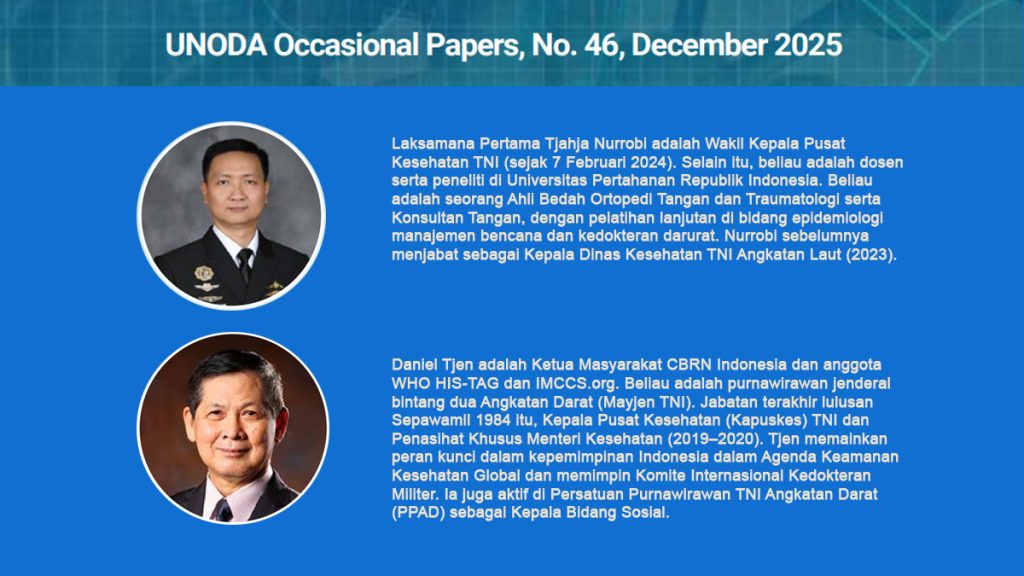
Tjahja Nurrobi and Daniel Tjen
________________________________
Pengantar Redaksi
Pemikiran dua tokoh kesehatan militer Indonesia, Laksamana Pertama TNI Tjahja Nurrobi dan Mayjen TNI Purn Daniel Tjen baru-baru ini berhasil masuk jurnal UNODA (United Nations Office for Disarmament Affairs), Kantor Urusan Perlucutan Senjata PBB yang didirikan untuk mempromosikan perlucutan senjata dan non-proliferasi senjata internasional. Jurnal UNODA dikenal dengan UNODA Occasional Papers. Berisi serangkaian publikasi makalah, pernyataan, atau hasil seminar, lokakarya, dan pertemuan internasional. Seri ini berfokus pada isu-isu terkini terkait pembatasan senjata, perlucutan senjata, dan keamanan internasional.
_________________________________
INDONESIA, AN ARCHIPELAGIC NATION OF MORE
than 17,000 islands, faces widespread challenges from emerging and re-emerging infectious diseases, including dengue, malaria, HIV/AIDS, tuberculosis, hepatitis and other viral illnesses. The difficulty is compounded by a population exceeding 280 million, diverse ecosystems, and uneven healthcare infrastructure. Beyond naturally occurring infections, Indonesia is also vulnerable to anthropogenic risks associated with emerging diseases and dual-use research. The high incidence of dengue, malaria, HIV/AIDS, tuberculosis, hepatitis and viral diseases such as avian influenza (H5N1) and COVID-19 illustrates these vulnerabilities. Dense populations, extensive animal husbandry and close human-wildlife interactions are the root causes.
While national and international collaborations have advanced vaccines and diagnostic development, such research carries the potential for misuse, including the engineering of dangerous pathogens. Experts assess that naturally occurring infections pose the greatest risk, the laboratory accidents a moderate risk and deliberate use of biological agents an extremely low risk. Large-scale biological weapon use has not been documented,
yet security agencies remain vigilant due to the accessibility of biological materials. In response, Indonesia ratified the BWC through Presidential Decree No. 58 of 1991, affirming its commitment to global security and the peaceful use of biotechnology.
Despite this commitment, Indonesia lacks a comprehensive law addressing chemical, biological, radiological and nuclear security. There is no dedicated agency or ministry, nor specific Government funding for oversight on these issues. Responsibilities are dispersed across multiple ministries, often without effective coordination. As rapid advancements in biotechnology and life sciences introduce new risks, particularly related to bioterrorism and accidental releases, strengthening assistance, rapid response and preparedness is critical for Indonesia to implement the BWC effectively.
Strengthening assistance
Indonesia actively engages in ASEAN initiatives on chemical, biological, radiological and nuclear risk mitigation activities, including workshops, training exercises and information-sharing initiatives administered through the ASEAN Center of Excellence. In a recent milestone, ASEAN Leaders issued their Declaration on Strengthening Regional Biosafety and Biosecurity in 2024. Internationally, Indonesia collaborates with United Nations entities, including the World Health Organization (WHO), as well as the Global Health Security Agenda network to enhance technical capabilities and readiness. Article
VII of the BWC empowers Indonesia to request and provide assistance during biological emergencies, underscoring its proactive role in global biosecurity.
Rapid response
Indonesia’s experiences with avian flu outbreaks and the COVID-19 pandemic have been pivotal in shaping its biological threat management initiatives. The crises fostered comprehensive civil-military collaboration, integrating health authorities with the National Defense Forces to support logistics, enforce social distancing, and disseminate public health information. They also gave rise to a culture of collaboration among academia, industry, government and media.
The response strengthened biosafety, biosecurity and risk management practices, several laboratory safety protocols having originated as part of avian flu preparation and response. The COVID-19 pandemic accelerated digital adoption and multisectoral coordination — lessons now embedded in Indonesia’s BWC preparedness framework. However, as a middle-income country, Indonesia faces financial burden to develop the BWC infrastructure.
Preparedness strategies
Article IV of the BWC obliges State parties to take any necessary measures — whether legislation, regulations or administrative provisions — to prohibit
and prevent the development, production, stockpiling, acquisition or retention of biological weapons. Indonesia has enacted the following:
• Law No. 17 of 2023 on Health, consolidating and revising prior health regulations
• Law No. 6 of 2018 on Health Quarantine, governing infectious disease control at borders
• Law No. 4 of 1984 on Outbreak Management, and Law No.
36 of 2009 on Health System Administration
• Ministry of Defense Regulation No. 5 of 2015, establishing protocols for on hazardous biological agents.
These regulations govern the export, import and transfer of certain biological agents and technologies. However, Indonesia lacks a unified Biological Security Bill. Efforts are under way to harmonize and modernize existing laws in line with international standards, but the bill’s pending status limits enforcement.
Preparedness relies on a multisectoral biodefense system spanning local health centres to national agencies. The Ministry of Health has enhanced laboratory capabilities, including Biosafety Level 3 (BSL-3) facilities. Emergency responses involve the National Disaster Management Authority, Ministry of Defense, Ministry of Health, National Defense Forces, National Police and the State Intelligence Agency, supported by digital tools for disease mapping and contact tracing. The 2019 National Action Plan for Health Security, developed following a WHO-led Joint External Evaluation, aligns national preparedness with BWC obligations.
Future challenges
Indonesia faces five key challenges in implementing the BWC:
1. Verification gaps: The absence of an international verification mechanism results in heavy reliance on domestic enforcement.
2. Technological advances: Rapid progress in synthetic biology, gene editing and bioinformatics demand responsive legislation and expert oversight. Stronger dialogue between scientists and policymakers is essential, as current structures feature siloed communities with limited opportunities for ongoing interaction.
3. Geographic constraints: Archipelagic geography and uneven infrastructure hinder nationwide biosafety and biosecurity readiness, with remote provinces often lacking basic
capacity, trained staff or rapid response mechanisms for a biological emergency.
4. Institutional fragmentation: Despite progress, compartmentalized organizations and poor in information-sharing continue to undermine efficiency. Clearer mandates, integrated whole-of-government mechanisms, and real-time data-sharing channels are critical to harmonize actions among government departments and scientific agencies.
5. Public awareness: Limited understanding of biosafety, biosecurity and BWC obligations necessitate broader education and outreach to civil society, academia and the private sector to help improve early detection, reporting and resilience.
Strategic investments in legal frameworks, infrastructure, training and regional cooperation are essential address these challenges.
Conclusion
Indonesia’s commitment to the BWC is evident in its legal frameworks, preparedness measures, and regional and global engagement. Lessons from the COVID-19 pandemic underscore the importance of multisectoral cooperation, especially civil-military partnerships, as demonstrated by the key contribution of the Indonesian Defense Forces in public health efforts. Moving forward, adaptive policies, capacity-building and public engagement will be crucial to strengthening Indonesia’s resilience against biological threats and upholding international security norms.
___________________________
References
• Adrian, W., et al. (2023). Operation ZENI TNI-AD in facing biological threats during the COVID-19 pandemic as a strategy to strengthen the country’s defense. International Journal of Humanities Education and Social Sciences (IJHESS), 2(5): 1519–1525. https://ijhess.com/index.php/ ijhess/article/download/385/373/4531
• Al Latief, M. N., et al. (2025). Kerja sama internasional Kementerian Pertahanan dalam menghadapi ancaman bioterorisme pasca COVID-19 di Indonesia. Jurnal Penelitian dan Pengabdian Masyarakat Indonesia,4(2). https://rayyanjurnal.com/index. php/aurelia/article/viewFile/5893/pdf
• Arianti, V. (2019). “Biological terrorism in Indonesia.” The Diplomat. Available at: https://thediplomat.com/2019/11/ biological-terrorism-in-indonesia/
• Aziz, I. R., and Saputra, A. (2017). “Bioterrorism: The role of genetics and molecular biology.” In Prosiding Seminar Nasional Biology forLife (Gowa, 10 November 2017). Universitas Islam Negeri Alauddin Makassar.
• Dwipratama, G. P. (2024). Pengembangan Senjata Biologi Sintetik Menggunakan Kecerdasan Buatan Sebagai Potensi Ancaman Faktual Non Militer Terhadap Pertahanan Negara. Website Direktorat Jenderal Potensi Pertahanan Kementrian Pertahanan RI. https://www.kemhan.go.id/pothan/ 2024/07/03/pengembangan-senjata-biologi-sintetik-menggunakan-kecerdasan-buatan-sebagai-potensi-ancaman-aktual-non-militer-terhadap-pertahanan-negara.html
• Flack, F. (2020). Kewaspadaan terhadap biohazard di Indonesia terkait pandemi global COVID-19 guna menjamin kepentingan nasional. Taskap PPRA Lemhannas RI. Available at: http://lib.lemhannas. go.id/public/media/catalog/0010-022100000000087/swf/7891/35.%20Friche%20Flack.pdf
• Kautsar, A. (2024). “Momen Pongrekun singgung COVID19 ‘senjata biologis’ di debat Pilgub Jakarta.” detikHealth. Available at: https://health.detik.com/ berita-detikhealth/d-7643710/momen-pongrekun-singgung-covid-19-senjata-biologis-di-debat-pilgub-jakarta
• Nuclear Threat Initiative (2025). “Biological Weapons Convention (BWC).” Available at: https://www.nti.org/education-center/ treaties-and-regimes/convention-prohibition-development-production-and-stockpiling-bacteriological-biological-and-toxin-weapons-btwc/
• Nurrobi, T. (2024). “Transformation of the global threat: What should we prepare? An analytic study of the COVID-19 pandemic.” International Review of the Armed Forces Medical Services, 97(2–3), 6–11. Available at: https://cimm-icmm.org/wp-content/ uploads/2024/12/97-2-6-11.pdf
• Permata, D., et al. (2023). “Strategic intelligence analysis of the threat of weapons of mass destruction proliferation: Potential vulnerability of Indonesia’s national security.” International Journal of Science and Society, 5(2). Available at: https://ijsoc.goacademica.com/index. php/ijsoc/article/download/703/650/
• Pusat Kesehatan TNI (2025). Pelatihan Biosafety Biosecurity, Epidemiology dan Biorisk Management. Pusat Kesehatan TNI Website. Available at: https://puskes-tni.mil.id/author/redaksi/ page/7/#:~:text=Pelatihan%20 Biosafety%20Biosecurity%2C%20 Epidemiologi%20dan%20Biorisk%20 Management&text=Pelatihan%20 berlangsung%20dari%20 tanggal%2020%20sd%2023%20 Pebruari%202024%2C%20 dengan%20diikuti%2030%20peserta
• Rimba, B. Y., and Nurrobi, T. (2023). “Wisma Atlet Kemayoran COVID-19 Hospital as the biggest COVID-19 hospital in the world: A lesson learned in the pandemic response in Greater Jakarta (Indonesia).” International Review of the Armed Forces Medical Services, 96(1), 4–12. Available at: https://www.researchgate.net/ publication/381023684_Wisma_Atlet_Kemayoran_Covid-19_Hospital_as_ the_Biggest_Covid-19_Hospital_ in_the_World_A_Lesson_Learned_ in_the_Covid-19_Pandemic_ Response_in_the_Greater_Jakarta_ Indonesia#fullTextFileContent
• Sari, M. I., et al. (2020). “The role of the defense institutions in handling the COVID19 pandemic.” Jurnal Pertahanan dan Bela Negara (JPBH), 10(2). Available at: https://jurnal.idu.ac.id/index.php/JPBH/ article/view/897
• Subiakto, Y. (2020). “Aviation medicine capacity on facing biological threat in Indonesia airports.” Infectious Disease Reports, 12(Suppl. 1). https://doi. org/10.4081/idr.2020.8738
• Surakusumah, A. H. I. N. P., and Putra, D. R. K. (2025). Indonesian Government’s Strategy in Dealing with the Development of Biological Threat in Indonesia by Utilizing the Role of Intelligence. SOSHUM Jurnal Sosial dan Humaniora, 15(2). https:// ojs2.pnb.ac.id/index.php/SOSHUM/ article/download/2458/1171/22522
• Ubaidillah, N. (2025). “Strengthening integrated emergency handling as part of global health resilience.” Jurnal Eduhealth, 16(1) https://doi. org/10.54209/eduhealth.v16i01
• United Nations Institute for Disarmament Research. (2025). Biological Weapons Convention National Implementation Measures Database: Indonesia. Available at: https://bwcimplementation.org/states/ indonesia
• United Nations Office for Disarmament Affairs. (2022). ASEAN Member States join workshop on the Biological Weapons Convention in Geneva. Available at: https://www. unoda.org/en/updates/asean-member-states-join-workshop-biological-weapons-convention-geneva
• United Nations Office for Disarmament Affairs (2022). Strengthening national, sub-regional and international capacities to prepare for and respond to the deliberate use of biological weapons: Project update. Ninth Review Conference of the States Parties to the BWC. Available at: https://docs. un.org/en/bwc/conf.ix/wp.41
• Wibowo, D. A., and Jamaludin, A. (2024). “Membangun sistem keamanan biologis: Kajian regulasi pencegahan senjata biologis di Indonesia [Building a biological security system: A study of biological weapons prevention regulations in Indonesia].” Les Nullius Law Journal, 6(1). https://ojs. unikom.ac.id/index.php/law/article/ download/11528/4164/40495