

















There are nights when football forgets to lie to you, and the summer evening in Munich in 2025 was one of them. Under the great white ribs of the Allianz Arena, before a congregation of 64,327, Paris Saint-Germain did not so much win a Champions League final as perform an execution.
Inter Milan came dressed for a war of attrition and left as a cautionary tale. Luis Enrique’s tactical masterclass was the real opening ceremony that night; whatever Linkin Park had done with the lights and the noise beforehand was forgotten by the twentieth minute, when Désiré Doué slid the first of his two goals home and began his evening of torment down the wing. By the sixty-third he had his second, his man-of-the-match medal effectively engraved long before István Kovács raised the whistle to his lips for the final time. Five goals. A demolition.
What we had been promised as a contest became a procession. That arguable midfield three — Vitinha, João Neves, Fabián Ruíz — did not merely beat Barella, Mkhitaryan and Çalhanoğlu; they annexed the middle of the pitch and charged rent. Kvaratskhelia and Doué carved the Italian giants open at will, and the humiliation was completed by the best right-back in the world, Achraf Hakimi, and by a teenage substitute named Senny Mayulu, who scored as though he had wandered in off the street and decided to help. It was beautiful. It was ruthless. It was, you had the nagging sense, purchased.
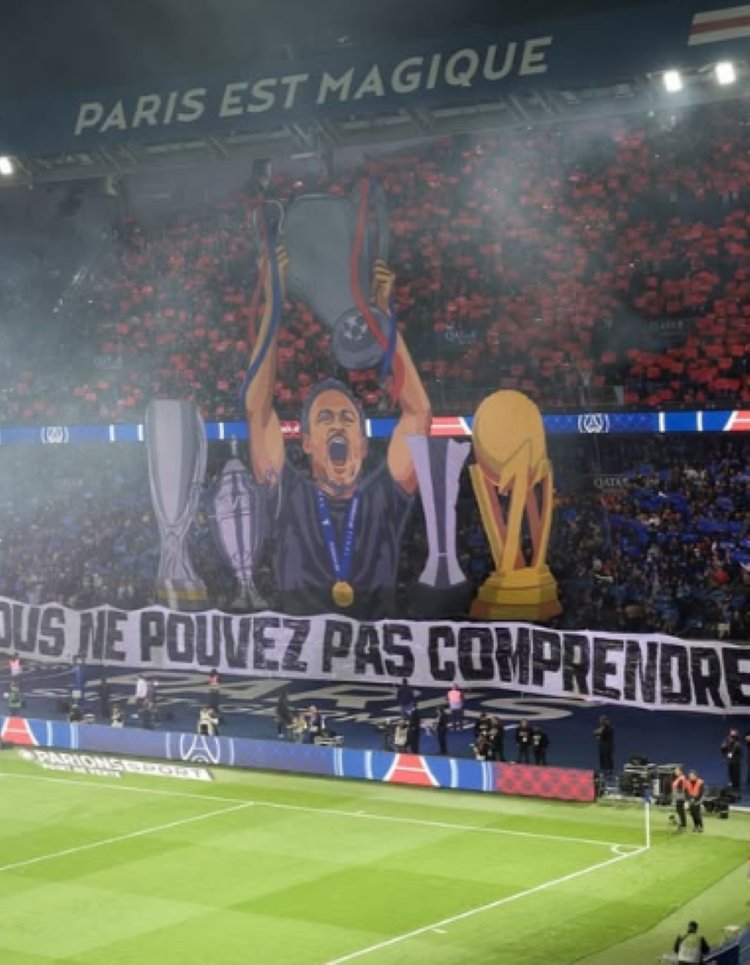
A year later they came back for more. Practically the same eleven walked out under the lights of the Puskás Aréna in Budapest in 2026 — the only meaningful change a goalkeeper, Matvey Safonov, filling the gloves Gianluigi Donnarumma had vacated for Manchester City in the autumn. The same unchanged midfield set about dominating in the same way, feeding the same always-hungry front three of Kvaratskhelia, Dembélé and Doué. It was the old script, and everyone in the stadium knew the ending.
Except Arsenal had not read it. The defense that had won them the Premier League stood firm, Saliba and Gabriel carrying themselves like men who had already decided the trophy was theirs, and when Kai Havertz stole in to score in the sixth minute, the certainty only hardened. PSG spent the night chasing — unbothered, unhurried, sure that an equalizer was a matter of arithmetic. It arrived in the sixty-first minute, when Mosquera bundled Kvaratskhelia over in the box and the German referee Daniel Siebert pointed to the spot without a flicker of doubt. The uniquely ambidextrous Dembélé stepped up and converted with the serene cruelty of a man who could have done it with either foot.
But Mikel Arteta, a graduate of the Guardiola school, had come to Budapest with a single, unglamorous idea: survive. Drag the killers to extra time. Drag them to penalties. Let Paris run rampant and hold the door shut anyway. And — like the Killers themselves, who had warmed the crowd before kickoff — Arsenal found a way to tame Paris’s killer instinct and force the shootout. Eze missed first. Nuno Mendes missed immediately after, nullifying the advantage, and for a moment the whole thing hung by a thread. Then, after five penalties each, Gabriel’s effort failed, and the door Arsenal had guarded so bravely swung open at last. PSG had their second European crown in a row — the first club to retain the trophy since Real Madrid’s imperial run in the back half of the 2010s.

And here the elegy must tell the truth. Luis Enrique did not build this dynasty alone, and he did not build it in two years. It has been under construction since 2011, since the evening Qatar decided a French football club would be a fine place to keep some of its money. Qatar Sports Investments made, at first, the same beautiful mistake every billionaire makes at the start: they bought names. The Ibrahimović years; the Neymar and Mbappé and, finally, Messi experiment — a galaxy of stars that never learned to orbit anything. It did not work. So they changed the shape of the spending, not the size of it. The exorbitant cheques kept coming, but now they went to role players chosen to serve the vision of a coach who had already won the thing with Barcelona.
The litany reads like a shopping list written by someone who never has to check the price. Dembélé, brought home to Ligue 1 from Barcelona as Messi, Neymar and Cavani were quietly phased out and the team rebuilt in his image. Doué from Rennes in 2024. Kvaratskhelia in 2025, freshly crowned in Serie A with Napoli. A midfield assembled piece by expensive piece — Vitinha from Porto by way of Wolverhampton, Fabián Ruíz from Napoli, the teenager João Neves from Benfica. A defense marshalled by the captain Marquinhos, reinforced with two of the finest full-backs alive in Hakimi and Nuno Mendes, and completed by the Ecuadorian William Pacho. Domestic titles were never in question — twelve in fourteen years, a monopoly dressed as a league. Only Europe had eluded them, because Ligue 1 was always dismissed as the weaker room, and building a side for the continent’s brightest night demanded a vision money alone could not draw up. PSG had the money. Enrique supplied the vision. The vision materialized.
But you cannot admire the cathedral without asking who paid for the stone. The shadow that trails QSI is longer than any trophy. Human rights groups have long called it what they believe it is — sportswashing, a state laundering its reputation through the beautiful game while its record on women and on LGBTQ+ people goes unexamined in the glow of the highlight reel. Corruption investigations have trailed the club’s leadership; its president has faced legal questions over payments tied to the awarding of major sporting events.
European rivals mutter, not without cause, about Financial Fair Play — about a state-backed treasury that bends the market to its will, inflates every transfer fee on the continent, and calls the resulting imbalance “ambition.” And the appetite has crossed the ocean now, into American arenas, into stakes in the teams of Washington, drawing the same outrage and the same uneasy boardroom reviews. Everywhere the money goes, the questions follow it like a shadow it cannot outrun.
This is the quiet obscenity the trophies are meant to drown out: that in modern football, money is not the reward for success but its first ingredient — poured in before the talent, before the tactics, before the teenager off the street who scores in a final. Talent is real. Vision is real. But they are luxuries a sovereign wealth fund can simply order in bulk. Paris is genuinely, undeniably beautiful to watch, and that is precisely what makes the other sentence so hard to say aloud: that we are applauding a masterpiece while trying not to notice the price tag still hanging from the frame. Bought and beautiful. Two in a row. And somewhere, a cheque is already being written for the third.***