


From the Evolution of Psychology to the Direction of Civilization
INTRODUCTION: THE PROBLEM THAT NEVER ENDS
For more than a century, humanity has tried to understand intelligence. Education teaches logic, psychology teaches emotion, and philosophy explores meaning. On the surface, modern humans appear increasingly intelligent.
Yet reality tells a different story: intelligent people fail, successful individuals collapse, and even nations with grand concepts do not always evolve into great civilizations.
This raises a fundamental question:
Have we truly understood intelligence as a whole, or are we still seeing only fragments of it?
IQ: THE FOUNDATION — BUT NOT THE DIRECTION
Modern understanding of intelligence began with Intelligence Quotient (IQ), developed by Alfred Binet. IQ measures cognitive abilities: logic, analysis, speed of thinking, and problem-solving.
Psychometrically, IQ is classified as:
Below 70 → intellectual limitation
70–85 → low
85–100 → below average
100–110 → average
110–130 → above average
130–145 → highly gifted
Above 145 → genius
Most people fall within the normal range, meaning they can think, but not necessarily understand complexity deeply.
Figures like Albert Einstein demonstrate the highest level of cognitive ability. He constructed models of reality in his mind, understanding space and time before others could.
However, this reveals the limitation of IQ:
IQ enables humans to understand reality, but it does not determine the direction of reality.
FREUD: HUMAN BEINGS ARE NOT PURELY RATIONAL
Sigmund Freud transformed this perspective by revealing the unconscious mind. Human decisions are not driven purely by logic, but also by hidden emotions, past experiences, and psychological impulses.
From this, intelligence was no longer seen as purely cognitive.
EQ: EMOTIONAL INTELLIGENCE AND ITS LIMITS
Through Daniel Goleman, Emotional Quotient (EQ) was introduced. It includes self-awareness, emotional control, empathy, and social skills.
A figure like Nelson Mandela exemplifies EQ—his ability to manage emotions under extreme pressure reshaped history.
Yet EQ also has limits:
EQ stabilizes human interaction, but does not guarantee correct direction in complex situations.

SQ: MEANING AND THE PATH TO ACHIEVING IT
Spiritual Quotient (SQ), introduced by Danah Zohar, addresses the deeper question of meaning: Why do we live? What values guide us?
SQ is not acquired instantly. It develops through:
deep reflection
life experiences
suffering and loss
inner awareness
silence (meditation, prayer, solitude)
Figures like Socrates embody this pursuit of meaning.
However, SQ also has limitations:
Understanding meaning does not automatically translate into the ability to read direction.
REALITY EXPOSES THE LIMITS OF PARTIAL INTELLIGENCE
Consider Marilyn Monroe and Michael Jackson.
They possessed talent, influence, and even a search for meaning. Yet they collapsed under pressure.
This is not an anomaly. It is a pattern.
Fragmented intelligence cannot sustain life.
AQ: THE POWER OF RESILIENCE
Adversity Quotient (AQ) represents the ability to endure hardship.
The strongest example is Viktor Frankl. In concentration camps, survival was not determined by intelligence, but by the ability to hold meaning under extreme suffering.
AQ is the intelligence of survival when all systems collapse.
MQ: MORAL DIRECTION
A powerful example is Adolf Hitler.
He possessed intelligence, influence, and resilience. Yet without moral grounding, these became destructive forces.
Without MQ, intelligence becomes a weapon of destruction.
ISQ: THE INTELLIGENCE OF DIRECTION
At this point, a critical question emerges:
Who determines direction?
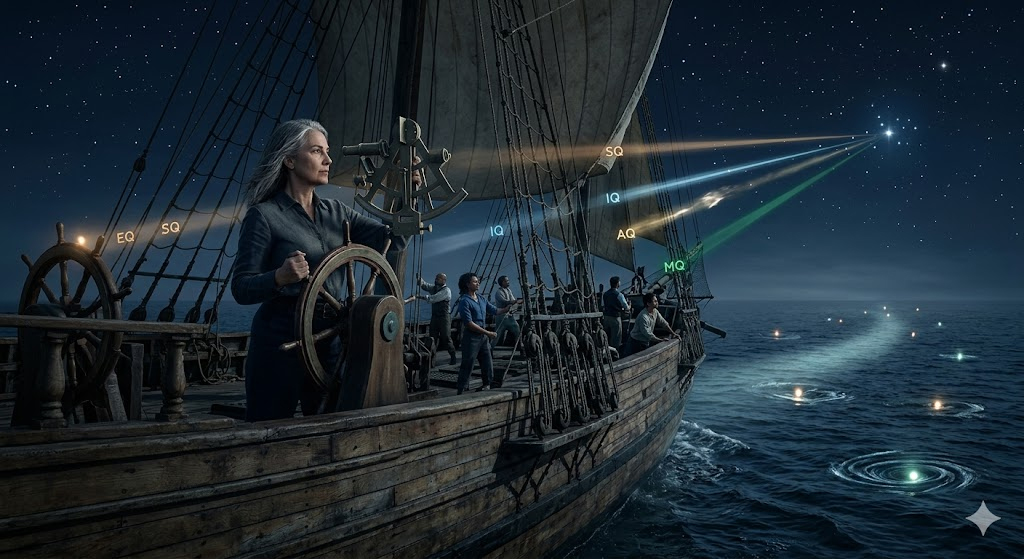
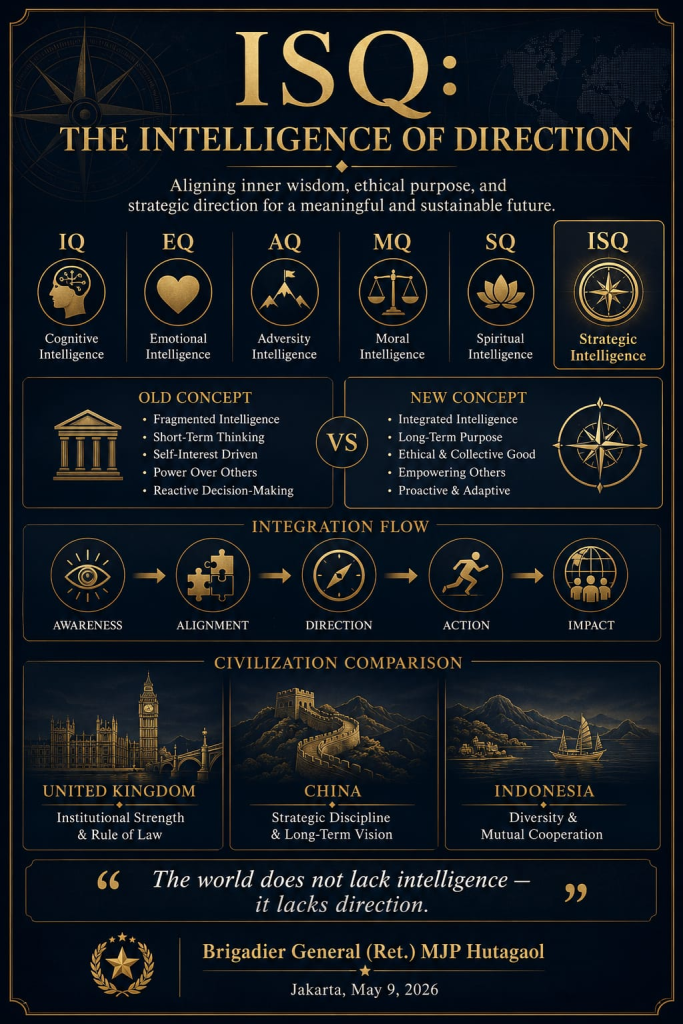
ISQ (Intuitive Strategic Quotient) is the integration of all intelligences—logic, emotion, resilience, morality, and meaning—into the ability to read direction before it becomes visible.
If SQ asks:
“What is the meaning of life?”
ISQ asks:
“Where is life heading, and what decision must be made now?”
HOW ISQ IS DEVELOPED
ISQ is not theoretical. It is formed through:
accumulated life experience
deep observation (pattern recognition / “titen”)
reflective thinking
emotional stability
moral grounding
courage to decide under uncertainty
ISQ emerges when one sees patterns behind events, not just events themselves.
FIGURES WHO DEMONSTRATE ISQ
Nikola Tesla envisioned global electrical systems before the world was ready.
Soekarno foresaw identity conflicts and established ideological direction early.
Abdurrahman Wahid recognized pluralism as the future long before it became mainstream.
Suharto translated direction into structured development through long-term planning.
ISQ AT THE LEVEL OF CIVILIZATION: GRAND STRATEGY
United Kingdom did not merely conquer territories—it built language, legal systems, and global frameworks that outlived its empire.
China, since 1949, has demonstrated long-term directional consistency, transforming itself into a global power.
Indonesia possesses vision and systems, yet struggles with maintaining consistent direction.
Civilizations do not rise because they are the smartest, but because they sustain direction over time.
COMPARISON OF CONCEPTS
Traditional framework:
IQ – EQ – SQ
Expanded framework:
IQ – EQ – AQ – MQ – SQ – ISQ
The difference is clear:
The old framework explains humans.
This framework determines human direction.
FINAL CONCLUSION
Humanity does not lack intelligence.
Humanity lacks integrated and directed intelligence.
The future is not shaped by those who think the most,
but by those who can read direction—and sustain it.
🌍 GLOBAL QUOTES
“The future is not decided by the smartest minds,
but by those who can see direction before it appears.”“Intelligence explains the world,
but only integrated intelligence defines its direction.”“Nations rise not by knowledge alone,
but by the discipline to sustain their direction.”
CLOSING
Jakarta, May 9, 2026
Brigadier General (Ret.) MJP Hutagaol