
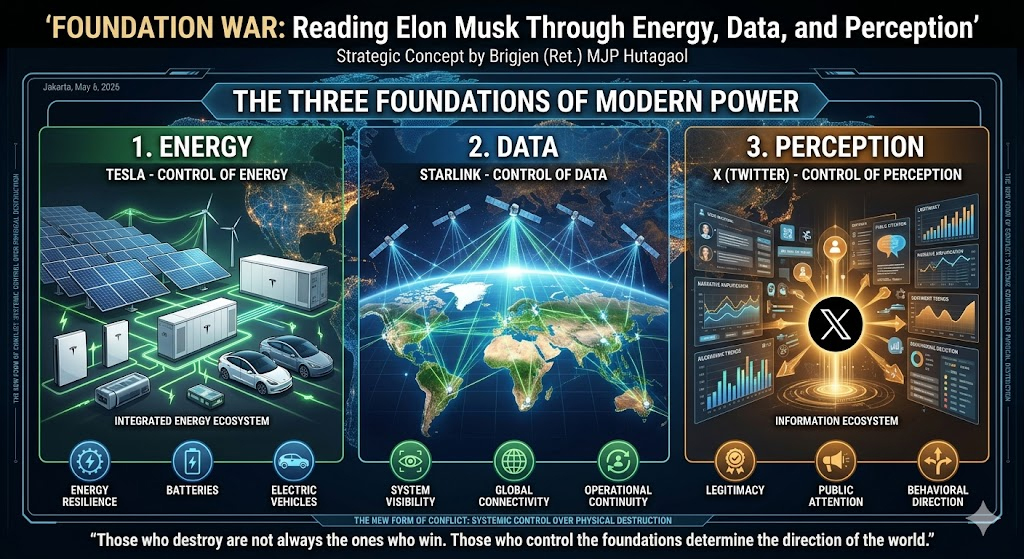
Reading Elon Musk Through Energy, Data, and Perception
Strategic Concept by Brigjen (Ret.) MJP Hutagaol
ABSTRACT
This paper introduces Foundation War as a framework for understanding modern global conflict.
Unlike conventional modern warfare—which focuses on methods, military operations, and battle domains—Foundation War focuses on what is actually being contested beneath the surface of global events:
energy,
data,
and perception.
The central argument is that nations no longer need to be physically destroyed in order to be weakened or controlled.
In the 21st century, influence over the foundational systems that keep societies functioning can shape the direction of states without open war.
Through the case of Elon Musk and his technological ecosystem, this paper illustrates how modern power increasingly operates through the control of foundational systems rather than traditional military force alone.
THE WAR THAT NO LONGER LOOKS LIKE WAR
The modern world appears relatively stable.
Cities continue functioning. Markets continue operating. Governments remain standing.
Yet beneath this apparent stability, a profound transformation is taking place.
War has not disappeared.
It has changed form.
Traditional conflict relied on:
armies,
weapons,
territorial occupation,
and physical destruction.
Modern conflict increasingly moves beneath the visible layer of war.
It enters the systems that allow nations to:
function,
communicate,
survive,
and make decisions.
The objective is no longer always destruction.
The objective is direction.
A nation may remain physically intact while gradually losing control over its strategic direction.


FROM HOW WAR IS FOUGHT TO WHAT IS BEING CONTROLLED
Concepts such as:
cyber warfare,
hybrid warfare,
information warfare,
and economic warfare
describe how pressure is applied in modern conflict.
But Foundation War asks a deeper question:
What must be controlled in order to influence a nation without destroying it?
The answer lies in three interconnected foundations:
energy,
data,
and perception.
THE THREE FOUNDATIONS OF MODERN POWER
- ENERGY
Energy is the operational foundation of civilization.
Without energy:
AI systems stop,
communication collapses,
industries halt,
financial systems freeze,
and governments lose operational rhythm.
Electricity is no longer merely infrastructure.
It is the lifeblood of modern civilization.
This explains why:
power grids,
batteries,
fuel systems,
rare earth minerals,
and energy supply chains
have become strategic assets.
Who controls energy controls the ability of systems to survive.
- DATA
Data is no longer simply information.
It is:
visibility,
connectivity,
coordination,
and real-time control.
Modern states depend on:
cloud systems,
satellites,
fiber-optic infrastructure,
digital platforms,
and communication networks.
Without data, a nation becomes strategically blind.
Who controls data controls the direction of systems.
- PERCEPTION
- Perception shapes legitimacy and decision-making.
Modern conflict increasingly operates through:
narratives,
algorithms,
social media,
psychological influence,
and information ecosystems.
Public perception can:
move markets,
influence elections,
trigger panic,
destabilize governments,
and reshape geopolitical alignments.
Today, perception itself has become a battlefield.
Who controls perception influences the direction of human decisions.
ELON MUSK AS A FOUNDATION WAR CASE STUDY
Elon Musk represents one of the clearest modern examples of Foundation War dynamics.
His ecosystem simultaneously operates across all three foundations.
TESLA — CONTROL OF ENERGY
Tesla is often viewed as an automotive company.
But its deeper significance lies in energy infrastructure.
Tesla develops:
electric vehicles,
batteries,
Powerwall systems,
solar energy,
and decentralized energy ecosystems.
Its strategic value is not merely transportation.
It is energy resilience.
In Foundation War terms, Tesla represents an effort to decentralize operational power away from vulnerable centralized systems.
Energy independence becomes strategic independence.
STARLINK — CONTROL OF DATA
Starlink operates within the second foundation: data and connectivity.
Modern societies rely on uninterrupted communication.
When terrestrial systems fail, satellite networks maintain:
command,
coordination,
visibility,
and operational continuity.
The conflict in Ukraine demonstrated this clearly.
Even when infrastructure was disrupted, communication survived through satellite-based systems.
This reveals a critical reality of Foundation War:
modern conflict targets rhythm rather than total destruction.
Who controls connectivity controls operational continuity.
X (TWITTER) — CONTROL OF PERCEPTION
The acquisition of Twitter—now X—represents the third foundation: perception.
In the digital era, influence increasingly operates through:
algorithms,
information flows,
narrative amplification,
and public attention.
A single narrative can:
influence markets,
alter political behavior,
shape legitimacy,
and redirect public emotion.
Perception no longer merely reflects reality.
It increasingly shapes reality itself.
In this sense, X is not simply a social media platform.
It is a strategic perception environment.
THREE FOUNDATIONS, ONE ECOSYSTEM
Tesla. Starlink. X.
Energy. Data. Perception.
These are not isolated sectors.
They form an integrated ecosystem of influence.
Energy keeps systems alive.
Data keeps systems connected.
Perception directs decisions.
When all three foundations interact within one ecosystem, influence extends beyond conventional business power.
It approaches systemic strategic power.
THE RISE OF NON-STATE STRATEGIC ACTORS
Traditionally, geopolitical influence belonged primarily to states.
Today, technological actors increasingly possess strategic influence comparable to—or even greater than—many nations.
Technology corporations now influence:
communication,
energy,
data flows,
public opinion,
and behavioral direction.
This changes the nature of sovereignty itself.
Power no longer depends solely on territory and military force.
It increasingly depends on who controls the foundations of modern civilization.
THE NEW FORM OF CONFLICT
The greatest transformation of the 21st century may not be artificial intelligence itself.
It may be the transition from: physical destruction
to
systemic control.
Because modern civilization depends entirely upon:
energy,
data,
and perception.
And when these foundations are disrupted, a nation does not need to collapse physically in order to lose strategic direction.
It only needs to be influenced from within.
STRATEGIC IMPLICATIONS
Foundation War creates a new geopolitical reality:
conflict becomes silent and systemic,
influence replaces occupation,
disruption replaces invasion,
and control replaces destruction.
Victory is no longer determined solely by military superiority.
It increasingly depends on who controls the foundational systems of civilization.
CONCLUSION
Elon Musk may never explicitly use the term Foundation War.
Yet the structure of his ecosystem reflects its logic with remarkable clarity.
Energy. Data. Perception.
These three foundations increasingly define the architecture of modern power.
And in the emerging global order, the actors who control these foundations may shape the direction of nations without firing a single shot.
FINAL PHILOSOPHICAL STATEMENT
In Foundation War, defeat is rarely announced openly.
It occurs when strategic direction slowly shifts beyond a nation’s own control.
There are no explosions. No visible occupation. No formal surrender.
Only decisions, dependencies, and directions that gradually cease to belong to the nation itself.
FINAL QUOTE
“Those who destroy are not always the ones who win.
Those who control the foundations determine the direction of the world.”
Jakarta, May 6, 2026
Brigjen (Ret.) MJP Hutagaol